

You asked three contractors for a bathroom quote and got three numbers you can't compare. Different totals, different line items, and no obvious way to tell which one covers the same job.
The cheapest one may not be the best deal.
A low quote often leaves out disposal, waterproofing, or a tile allowance big enough to buy the tile you want. An allowance is a placeholder budget for an item you haven't picked yet. When it runs out, you pay the difference.
Angi puts the Orlando average at $10,510, with most homeowners paying between $5,709 and $15,372 (Angi, updated Feb 25, 2026). That spread is wide, so what matters is the work behind each number.
Then there are change orders. A change order is a written price increase for work the original quote left out. It usually arrives mid-job, after the toilet is gone, the floor is open, and you can't use the bathroom.
This guide fixes that. It gives Orlando cost ranges with a source and date for each one. Then it lists, line by line, what a complete quote should contain. It also covers the Florida paperwork the quote should reflect and shows how to compare three quotes side by side.
It's written for Orlando-area homeowners who have quotes in hand or are about to ask for them. If you're only looking for tile ideas, this isn't that guide.
One more thing: this guide sells no remodeling services or products. Where it makes a claim about Florida law or city rules, it links to the statute or city page so you can check it yourself.
Orlando Cost at a Glance
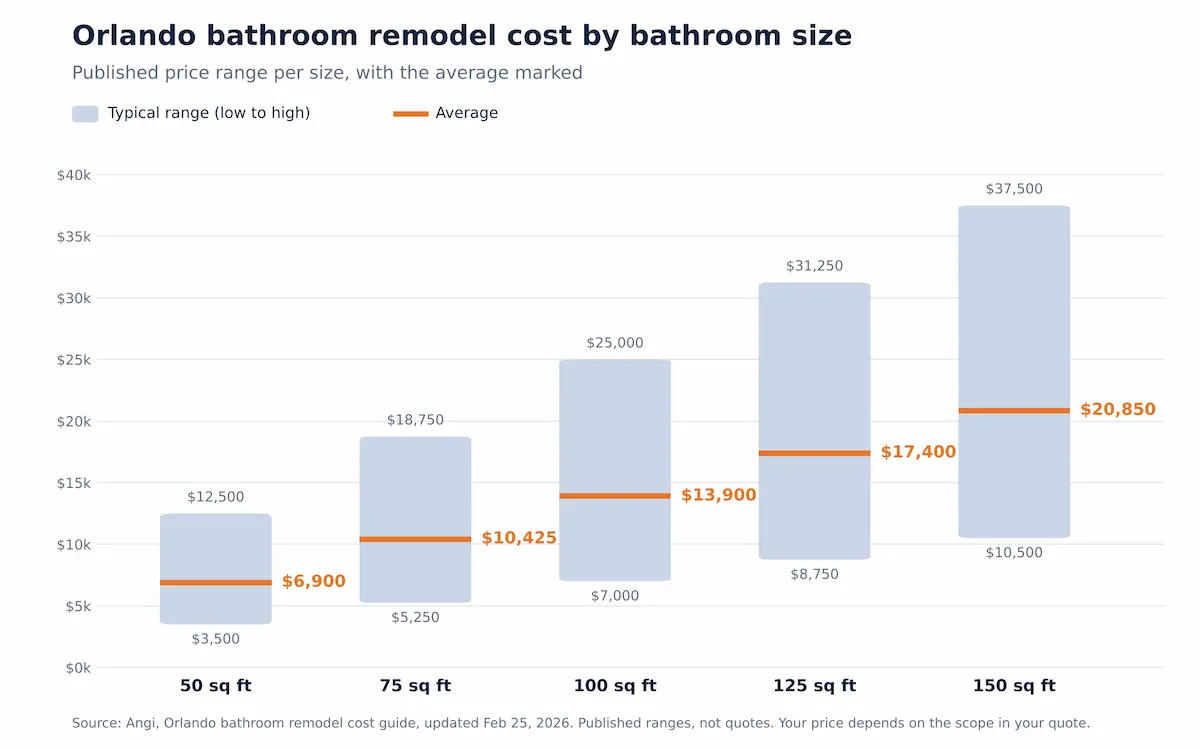
Most Orlando bathroom remodels land between about $5,700 and $15,400, according to Angi. A full remodel can cost far more. What decides where yours falls is the scope written in your quote.
| Bathroom size | Average | Range |
|---|---|---|
| 50 sq ft | $6,900 | $3,500–$12,500 |
| 75 sq ft | $10,425 | $5,250–$18,750 |
| 100 sq ft | $13,900 | $7,000–$25,000 |
| 125 sq ft | $17,400 | $8,750–$31,250 |
| 150 sq ft | $20,850 | $10,500–$37,500 |
What each scope means:
• Cosmetic refresh: New paint, fixtures, and maybe a vanity. Plumbing stays where it is.
• Partial remodel: At least one main fixture is replaced, often the shower area retiled. The layout stays the same.
• Full remodel: Angi defines it as replacing every fixture and surface without moving plumbing. USA Cabinet Store defines it as stripping the room to the studs and rebuilding. That gap is one reason the ranges differ.
• Primary / master bath: A full remodel of a larger room, often with a separate tub and shower and a double vanity.
• Upscale / luxury: Custom cabinets, frameless glass, premium fixtures, and often layout or structural changes.
: Angi also gives a per-square-foot figure for Orlando: about $140, with a range of $70 to $250. Use it to sanity-check a quote. A 60 sq ft bathroom at about $8,400 sits near the middle, but only if the scope matches.
What Drives Your Bathroom Remodel Price in Orlando
Most of the price comes from a handful of line items. Once you know them, the quotes become easier to read.
Size and layout
Price rises with square footage. Table 1 shows the steps. Angi's Orlando averages go from $6,900 at 50 sq ft to $20,850 at 150 sq ft (Angi, updated Feb 25, 2026).
Layout matters more than size, though. A small bathroom where the plumbing gets moved can cost more than a large one where everything stays in place.
Moving plumbing
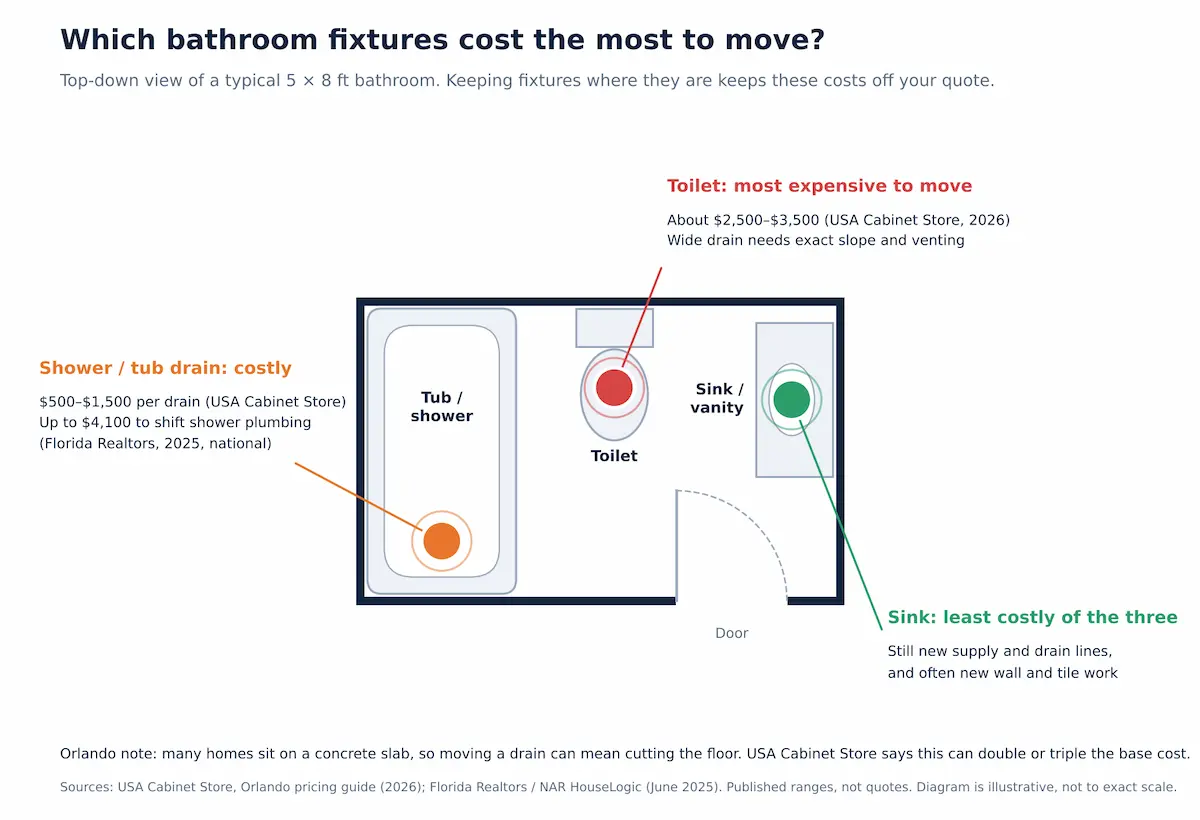
Moving the shower plumbing to a new spot can cost as much as $4,100 (Florida Realtors, June 2025, reprinted from the National Association of Realtors' HouseLogic; national figure).
This is the most useful question to ask about your own layout: Does anything move? If the answer is yes, every quote should show it as its own line.
Materials and fixtures
Fixture prices vary widely, so the quote's allowances matter. Here are national ranges (Florida Realtors/HouseLogic, June 2025):
• Toilets: $350–$3,500
• Sinks: $300–$5,500
• New tub installation: $1,500–$2,900
• Ceramic or porcelain tile: $10–$44 per sq ft, installed
A tile allowance at the low end of that range buys a very different shower than one at the high end. If the allowance is lower than what you plan to pick, you pay the difference later.
Labor
Labor is the largest single piece. Sources put it at 35% to 65% of the total, depending on who counts what. HanoDecor says 35–45% nationally (April 2026). Angi puts Orlando labor at $4,200–$6,900, or 40–65% of the total (Feb 2026).
The gap comes from counting. Some sources fold plumbing, electrical and supervision into "labor"; others list them as separate lines.
Age of the home
Older bathrooms hide more. You often can't see rotted subfloor or outdated pipes until the walls are open. That's what the contingency line is for, covered in the allowances and contingency section.
Demolition, disposal and permits
Demolition adds $1,000–$2,300 in Orlando, according to Angi (Feb 2026), which advises checking that the cost is in your contractor's estimate. Hauling away the old tile and fixtures may take a separate junk removal service at about $100–$800.
If neither line appears on a quote, ask about both. Permits get their own section below.
Waterproofing
In a humid climate, waterproofing is the line that protects everything else. A shower can look perfect on day one and still let water into the wall behind the tile. Orlando's air keeps those walls damp, so a weak membrane fails sooner.
A good quote names the waterproofing method. A vague one says "prep walls." Ask which product they use and whether they test it before tiling.
Keep the toilet, sink and shower where they are. Spend on one high-end focal point, like the vanity or the shower tile, and use mid-range finishes everywhere else
Estimate, Quote or Bid: Know What You Are Holding
Before you compare prices, check what kind of document you're holding. Contractors use these three words loosely, and they mean different things.
An estimate is a ballpark. It's an approximate number, often given before the contractor has inspected the room in detail. It doesn't bind anyone, and the final price can move a lot. HanoDecor puts the swing at 15–25% or more (April 2026).
A quote is a specific price. It lists materials, labor, fixtures and a timeline for a defined scope of work. Once accepted, it's generally binding, as long as the scope doesn't change.
A bid is a formal competitive offer. It's priced against a written scope that several contractors receive. Bids are usually the most detailed and binding of the three, with itemized costs, a timeline, a payment schedule and warranty terms.
| Document | Binding? | Detail level | What to do with it |
|---|---|---|---|
| Estimate | No | Low; often made before a full site visit | Use it to plan your budget. Don't sign from it. |
| Quote | Generally yes, for the stated scope | Medium to high; materials, labor, fixtures, timeline | Check it against the checklist in the next section. |
| Bid | Yes, usually the most firmly | Highest; itemized, with schedule, payments and warranty | Line it up against other bids on the same scope. |
Never sign from an estimate.
Whatever the paper is called, ask two questions:
• "Is this price binding, and for how long?"
• "What would make it change?"
The answers matter more than the label. A document called an "estimate" that commits to a price in writing is worth more than a "quote" that hedges every line.
Why this matters in Orlando
Bathroom remodels often run over budget. HanoDecor says bathroom renovations exceed their original budget by 20–30% on average and attributes the figure to the National Association of Home Builders (Not confirmed - verify).
On a $15,000 job, that range means $3,000–$4,500 you didn't plan for. In Orlando, the overrun often shows up after demolition, when the floor is open and the bathroom can't be used.
A firm quote with a written change-order process caps that risk. A change order is a written price change for work outside the original agreement. A low estimate caps nothing.
What to Include in Your Contractor Quote
A complete bathroom quote lists every cost as its own line, names every product, and states what isn't included.
That sentence is the whole test. Most of the trouble in remodel quotes comes from lines that are missing, lumped together or vague. The table below lists 15 items a complete quote should cover. For each one, it shows a good line and a warning sign.
The items come from HanoDecor's list of what a professional bid should itemize (April 2026), with additions from USA Cabinet Store's Orlando guide (2026) on exclusions, glass, supervision, material ordering and written payment terms.
| # | Quote item | A good line looks like | Warning sign |
|---|---|---|---|
| 1 | Contractor identity | Legal business name, license number, proof of insurance, address and phone | Only a first name and a cell number |
| 2 | Scope of work | Written scope that matches your measurements and photos, room by room | "Remodel bathroom" with no detail |
| 3 | Demolition and disposal | Its own line, with debris removal named | Disposal missing or folded into labor |
| 4 | Plumbing | Labor and materials separate, with any fixture moves listed | One lump sum for "plumbing" |
| 5 | Electrical | Separate line for outlets, GFCI, lighting and fan | Not mentioned |
| 6 | Waterproofing | Method and products named for shower and floor | "Waterproofing included" with no method |
| 7 | Tile and flooring | Tile size, material and installation priced, with the allowance stated | A single price for "tile" |
| 8 | Fixtures and vanity | Each item with model number and price | "Standard fixtures" |
| 9 | Allowances | Each allowance amount, what it covers and whether it includes installation | Low allowances that won't buy the finishes you chose |
| 10 | Permits and inspections | Who pulls the permit, the fee and who pays it | "Permits as needed" |
| 11 | Timeline | Start date, milestones and completion date | No dates |
| 12 | Payment schedule | Payments tied to milestones, final payment after punch list | Large deposit before work begins |
| 13 | Change orders | Written procedure and how extra work is priced | Verbal approvals |
| 14 | Warranty | Length and what is covered, in writing | "Satisfaction guaranteed" |
| 15 | Exclusions | A short list of what the price does not cover | No exclusions listed |
A few terms in the table need a definition. GFCI (ground-fault circuit interrupter) is the type of outlet that shuts off power when it detects a fault, which is required near water. A punch list is the final list of small fixes, like a chipped tile or a loose towel bar, that the contractor finishes before the job is called done.
Most items explain themselves in the table. Three need more room.
Item 9: Allowances
An allowance is a placeholder budget for something you haven't picked yet, such as tile, a vanity or light fixtures. It keeps the quote moving before you've made every choice. It's also the easiest place for a quote to look cheaper than it is.
HanoDecor gives an example. If a contractor's tile allowance is $5 per square foot but you want tile that costs $12, raise the allowance before you sign, not after.
The reason is the markup. Most contracts bill an overage (the amount you go over an allowance) as a change order. HanoDecor says the contractor's markup on that change order is typically 10–20% (Not confirmed - verify). If you come in under an allowance, you usually get the difference back at face value, with no markup.
So going over costs more than the price gap alone. Illustrative example: say the job needs 100 sq ft of tile. The $7-per-foot gap is $700, and a 10–20% markup brings it to $770–$840.
For every allowance, ask two things: what specific products it would buy, and whether it covers installation or materials only.
Item 12: Payment schedule
Payments should follow the work, not run ahead of it. A good schedule ties each payment to a finished milestone you can see, and holds back the final payment until the punch list is done.
HanoDecor suggests about 10% at signing, then payments at rough-in, tile completion and the final walkthrough. It advises never paying more than 10–15% upfront. Rough-in is the stage when new pipes and wires are in place but the walls are still open.
USA Cabinet Store calls a 10–20% deposit normal and flags 50% upfront as a warning sign. It also says to get the terms in writing.
Florida has its own rules on deposits and on the paperwork that protects you from liens. A lien is a legal claim against your property, for example by an unpaid supplier. Those rules are covered in the next section. Read it before you agree to any deposit.
Item 15: Exclusions
Exclusions are the most important lines on the page, because they're the ones a low quote leaves off.
USA Cabinet Store makes the point directly. Orlando quotes vary a lot depending on whether glass, disposal, permits, supervision and material ordering are included. A "cheap" bid that leaves out $4,000 of line items isn't cheap.
A good quote states its exclusions in a short list. For example: "Shower glass not included." "Owner supplies vanity." "Repair of hidden subfloor damage billed at $X per sq ft."
A quote with no exclusions isn't complete. It just hasn't said what's missing. Ask for the list in writing. Then add the excluded items back into the price before you compare it with the next quote.
Ask each contractor to price the checklist items on the same sheet. When every quote uses the same 15 lines, you can compare them line by line.
The Florida Paperwork Your Quote Should Reflect
Two Florida statutes shape what should appear in your contract, and both are easy to check.
The first requires a consumer-protection notice in the contract itself. The second sets deadlines for a contractor who takes a large first payment. The table below covers both, along with the licensing, permit and lien paperwork that comes with a bathroom job.
This section is general information, not legal advice.
What this means for your quote
Look for the Recovery Fund notice before you sign.
If the job is over $2,500 and the notice isn't in the contract, ask why. Its absence is a sign the contractor isn't using a Florida-compliant contract.
If the deposit is over 10%, write the permit date down.
The statute starts a 30-day clock for the permit application when you pay. Put the expected permit date in the contract. You then have a clear date to check against.
Ask who prepares the Notice of Commencement.
The contractor often prepares it, but the statute requires your signature and the recording. Check its expiration date. Don't make payments after it expires without asking your contractor or an attorney.
Ask whose name goes on the permit.
It should be the licensed contractor's. A contractor who asks you to pull an owner-builder permit is asking you to take on their legal risk.
Before you pay anything, ask for a copy of the contract with the Recovery Fund statement in it.
Allowances and Contingency: Setting Both Without Guessing
Allowances and contingency are two separate pots of money. Mixing them up is how a $14,000 job turns into $18,000.
An allowance is part of the contractor's price. A contingency is your own reserve, kept outside the quote.
Allowances: price your picks before you sign
An allowance is a placeholder amount for a finish you haven't chosen yet, such as tile, a vanity or a faucet. If your choice costs less, you get the difference back. If it costs more, you pay the difference.
The overage usually costs more than the price gap. HanoDecor says overages are typically billed as change orders with a 10–20% markup, while unused allowance money is usually credited at face value
The fix is simple, and it happens before you sign:
1. Choose your tile and fixtures, or at least a price range for each.
2. Price them at a store or supplier.
3. Ask the contractor to raise each allowance to match.
Changing an allowance on paper costs nothing. Changing it mid-job costs the gap plus the markup. Item 9 in the checklist shows what a good allowance line looks like.
Contingency: money for what's behind the wall
A contingency is money you set aside for problems nobody can see until the walls and floor are open. Examples include rotted subfloor, a corroded pipe or wiring that isn't up to code. The two sources give different figures:
| Source | Contingency guidance |
|---|---|
| USA Cabinet Store (Orlando, 2026) | 10–15% of the budget; homes built before 1990 should lean toward 15% |
| HanoDecor (national, April 2026) | 15% for bathrooms under 15 years old; 20% at 15–30 years; 25%+ past 30 years or with known moisture issues |
The sources disagree on the percentage but agree on what drives it: the age and condition of the bathroom matter more than the exact percentage. A bathroom from 2015 with no history of leaks needs a smaller reserve. A 1985 bathroom with a soft spot near the tub needs a larger one.
What the surprises cost
HanoDecor lists typical costs for problems found after demolition. These figures are national and HanoDecor gives no source for them, so treat them as rough planning numbers, not Orlando quotes:
• Mold or water damage: $500–$5,000+
• Plumbing surprises: $500–$3,000
• Electrical upgrades: $300–$2,000
• Structural issues: $1,000–$5,000+
A single structural problem can use up a 15% reserve on a mid-size job. That's why older bathrooms call for the higher end.
The two-line calculator
Quote total × 10–15% (newer bathroom, no known issues) = money to hold back
Quote total × 20–25% (30+ years old, or known moisture issues) = money to hold back
Illustrative example: on a $14,000 quote, that's $1,400–$2,100 for a newer bathroom, or $2,800–$3,500 for an older one.
You don't pay this money to anyone up front. You keep it available, and if the job finishes without surprises, it stays yours.
Keep the contingency as its own line in your budget. Don't ask the contractor to build it into the quote. Money hidden in a quote tends to get spent. Money in your account gets spent only on a written change order you approve.
How to Compare Three Quotes Line by Line
You can't compare three quotes by their totals. First you have to make them describe the same job. That takes four steps.
Step 1: Give every contractor the same job
Before anyone quotes, hand each contractor the same package:
• A written scope of work, room by room
• Measurements, including ceiling height
• Photos of the bathroom from several angles
• Your wish list, split into must-haves and nice-to-haves
• The tile, vanity and fixtures you've chosen, or links to them
HanoDecor recommends getting three to five quotes (April 2026). Fewer than three doesn't give you enough to compare, and more than five gets hard to manage. Allow a couple of weeks after each site visit for a detailed quote to arrive.
If one contractor is quoting a different bathroom than the others, the comparison is broken before it starts.
Step 2: Copy each quote into one worksheet
Use the 15 items from the checklist as rows and give each contractor a column. Copy each quote's price and wording into the matching row.
Where a quote doesn't mention an item, write "not listed." Don't leave the cell blank, and don't assume the item is included. A blank cell looks like nothing is missing. "Not listed" reminds you to ask.
Step 3: Price what's missing before you compare totals
For every "not listed" row, estimate what the item will cost. Then add that to the quote's total. Use a figure from another quote in your stack, or a published range like Angi's Orlando demolition cost.
Do the same for allowances that are too low. If a quote's tile allowance won't buy the tile you picked, add the difference.
Only after this step are you comparing the same bathroom.
Step 4: Call about the gaps, then compare again
Your estimates are guesses until the contractor confirms them. Call each one about their "not listed" rows:
• "Your quote doesn't list disposal. Is it included? If not, what will it cost?"
• "How is the shower waterproofed, and with what product?"
• "Can you raise the tile allowance to $2,600? That's what my tile costs."
Ask for the answers in writing, as a revised quote. Then update the worksheet and compare again.
A worked example
Here's how one cheaper quote loses its lead.
Illustrative example. All figures are invented to show the method. They are not real quotes. Same 60 sq ft bathroom, same fixtures chosen.
Line
Quote A
Quote B
Note
Demolition and disposal
Not listed
$1,800
Angi puts Orlando demolition at
$1,000–$2,300 (Feb 2026)
Waterproofing
"Included," no method
$900, method named
Ask how it is done
Tile allowance
$1,500
$2,600
The tile you chose costs $2,600
Permits
"As needed"
Included, contractor pulls
Confirm the fee
Quoted total
$12,400
$15,200
Total after adding A's gaps
$16,200
$15,200
$12,400 + $1,800 + $900 + $1,100
The added $1,800 for demolition and disposal comes from Quote B's line. The $900 for waterproofing is also B's price, since A named no method. The $1,100 is the tile gap: $2,600 minus A's $1,500 allowance.
The cheaper quote became the more expensive one once its missing lines were priced.
Quote A could cost even more than $16,200. Its permit fee is still unknown, and if the tile overage is billed as a change order, a markup may come on top of the $1,100.
That doesn't make Quote B the automatic winner. It means B is the only one of the two you can actually price. Call Contractor A, get the gaps filled in writing, and compare again.
Compare each allowance against the products you actually picked, not against the other quotes. Price your tile before you sign. If every contractor uses a low tile allowance, all three totals are too low.
Orlando Realities That Change a Quote
National cost guides miss a few things that move Orlando prices. None of them should surprise you if the quote is complete.
Humidity puts the pressure on waterproofing
Orlando's damp air means a shower that's poorly sealed fails faster. Badeloft's Florida guide stresses moisture-resistant materials and proper ventilation, and names porcelain tile and quartz countertops as sensible choices (Nov 2025). USA Cabinet Store lists porcelain tile and mold-resistant backer board as standard on a serious Orlando bath (2026).
What matters for your quote is the waterproofing method. A good quote names the membrane or system used in the shower and on the floor. "Waterproofing included" doesn't tell you anything.
Older homes hide more
Opening up an old bathroom tends to turn up more problems, which is why the contingency section ties your reserve to the bathroom's age. USA Cabinet Store treats homes built before 1990 as the point where you should budget toward the high end.
HanoDecor adds a second age line. Homes built before 1980 may contain asbestos in floor tile, pipe insulation or joint compound. It puts testing at $200–$400 and abatement at $1,500–$5,000 or more (national figures, no source given). If your home is that old, ask whether the quote covers testing before demolition.
Your address decides who issues the permit
Living near Orlando doesn't mean the City of Orlando issues your permit. According to USA Cabinet Store:
• Addresses inside city limits go through City of Orlando permitting.
• Unincorporated Orange County uses the county's own system.
• Kissimmee and St. Cloud addresses go through Osceola County.
Confirm which one applies to your address before you sign. A contractor who names the wrong office in the quote may not have handled your area before.
HOA and condo rules can add time
USA Cabinet Store says HOA-governed properties can add about one to two weeks to the permit timeline. Permitmint advises checking your CC&Rs and your HOA's architectural review process. CC&Rs are the covenants, conditions and restrictions your community sets. (Not confirmed - verify)
Interior work may not need HOA sign-off, but read your own CC&Rs rather than relying on a general rule. Condos often have extra rules for plumbing work and contractor access.
Hurricane season can slow deliveries
Bathroom work happens indoors, so storms rarely stop it. Deliveries are another matter. USA Cabinet Store says specialty tile, custom vanities and imported stone can run four to six weeks late when freight is disrupted during the June-to-November season. Order long-lead items early, or pick ones that are in stock locally.
Off-season timing: the sources disagree
HanoDecor says November through February can bring lower rates. That's national advice. USA Cabinet Store says the opposite for Orlando: October through February is peak booking season, when seasonal residents want work done, and July and August tend to have better availability.
For Orlando, the local source makes more sense. Either way, ask each contractor directly when their schedule opens up.
Who approves what
| Who | What they approve |
|---|---|
| City or county | Permits and inspections |
| HOA or condo board | Exterior changes, and any rules in your CC&Rs |
| You | The contract, every change order, and every payment |
Before you sign, ask each contractor: "If you open the wall and find water damage, what happens next, and how will you price it?" A good answer names a process: stop, photograph, write a change order, and get your approval before continuing.
Lower the Price Without Cutting What the Quote Needs
There are safe ways to bring a quote down, and ways that only move the cost to later. The difference is whether the cut removes something you'd notice, or something that protects you.
Cuts that work
Keep the plumbing where it is. Badeloft calls leaving fixtures in their original positions one of the best ways to keep costs down and speed up the job (November 2025). Moving a shower drain or toilet adds plumbing labor, waterproofing and often a permit. Keep the layout and those costs drop off the quote.
Spend on one focal point. Pick the item you'll see most, such as the vanity, the shower tile or the mirror. Put money there and use mid-range finishes everywhere else. Badeloft recommends mixing high-end focal points with mid-range finishes for a finished look without overspending.
Buy moisture-resistant materials once. In Orlando's humidity, a cheaper surface that holds moisture costs more over time. Badeloft names porcelain tile and quartz countertops as sensible choices for Florida.
Do the painting and decorating yourself. Florida Realtors, reprinting NAR's HouseLogic, says painting and decorating can lower costs, but plumbing, electrical and structural work belong with professionals (June 2025). Ask the contractor to take paint off the quote, and get the new price in writing.
Cuts that cost more later
Some savings only push the cost into the future. Keep these four lines in every quote:
• Permits. Skipping one can delay a sale or an insurance claim, and Florida law makes you responsible if you pull an owner-builder permit.
• Waterproofing. It's the line that protects everything else in the room.
• Contingency. It's money you hold, not money you spend.
• Licensed trades. Florida requires licensed plumbing and electrical work. Cheaper unlicensed labor shifts the risk onto you.
This guide recommends no specific products, brands or contractors.
Related guides: How to find the best contractor in Orlando · Orlando HVAC companies and AC repair costs
Is a Bathroom Remodel Worth It?
Partly. Most sources say you get back some of the cost at resale, but not all of it, and they don't agree on how much.
| Source | Return on cost | Scope |
|---|---|---|
| Angi (Feb 2026) | About 70% average return | Orlando |
| USA Cabinet Store (2026) | 65–80% | Orlando |
| Badeloft (Nov 2025) | About 60–70% for mid-range remodels | Florida |
| NAR via Florida Realtors (June 2025) | About 50% recovered | National |
The spread is wide because the sources measure different things. Some average all remodel types, others look only at mid-range work, and some survey real estate agents rather than sale prices. None of them guarantees a figure for your home.
Demand is real, though. NAR's 2025 Remodeling Impact Report says agents saw a 35% increase in demand for bathroom renovations over two years. It also says 24% of agents recommend sellers remodel the bathroom before listing.
What you get back depends on the scope you approve now. A clean, well-waterproofed mid-range bathroom with no layout changes holds its value better than a premium one built on a weak quote.
Frequently Asked Questions
How much does a bathroom remodel cost in Orlando?
Angi puts the Orlando average at $10,510, with most projects between $5,709 and $15,372 (updated Feb 25, 2026). Where yours falls depends on scope: moving plumbing, the tile you choose and the age of the bathroom move the price more than size does.
What should a bathroom remodel quote include?
A complete quote itemizes demolition and disposal, plumbing, electrical, waterproofing, tile, fixtures, allowances, permits, the timeline, the payment schedule, change orders, the warranty and exclusions. Each should be its own line. Use the 15-item checklist above to check every quote you receive.
How many quotes should I get?
Get at least three itemized quotes. Badeloft (2025) and USA Cabinet Store (2026) both recommend three, and HanoDecor suggests three to five (April 2026). Give every contractor the same written scope so the quotes describe the same job.
Is a contractor's quote binding?
An estimate is a non-binding approximation. A quote is generally binding for the scope it describes (HanoDecor, April 2026). Whatever the document is called, ask how long the price holds and what would change it, and get the answers in writing.
How much deposit can a Florida contractor ask for?
Florida law doesn't set a flat 10% cap on deposits. Under , if the first payment is more than 10% of the contract price, the contractor must apply for permits within 30 days and start work within 90 days of permit issue. Exceptions apply when no permit is needed, the contractor has just cause, or you agreed in writing to a longer period.
Do I need a permit for a bathroom remodel in Orlando?
Cosmetic updates generally don't need one. Moving plumbing, adding a bathroom or removing a wall does (Permitmint, 2026; Not confirmed - verify). Confirm with City of Orlando Permitting Services (407-246-2271) for city addresses, or with Orange County for unincorporated areas.
What is the Recovery Fund statement in my contract?
For residential work over $2,500, Florida requires the contract to include a written notice about the Florida Homeowners' Construction Recovery Fund. The notice says that payment, up to a limited amount, may be available if you lose money because of specified violations by a licensed contractor. A missing notice is a reason to ask questions before you sign.
How long does a bathroom remodel take?
The available sources give national ranges. A cosmetic refresh takes a few days to a week (Florida Realtors, June 2025), and a moderate remodel takes four to eight weeks (HanoDecor, April 2026). Florida Realtors suggests adding a week or two of buffer before you count on using the bathroom again.
 Orlando HVAC Companies and AC Repair Costs A Homeowner’s Comparison Guide
 Free and Low-Cost Halloween Events in Orlando for Families Guide
 Builder Gel Nails in Orlando Prices, Fills and Where to Book
